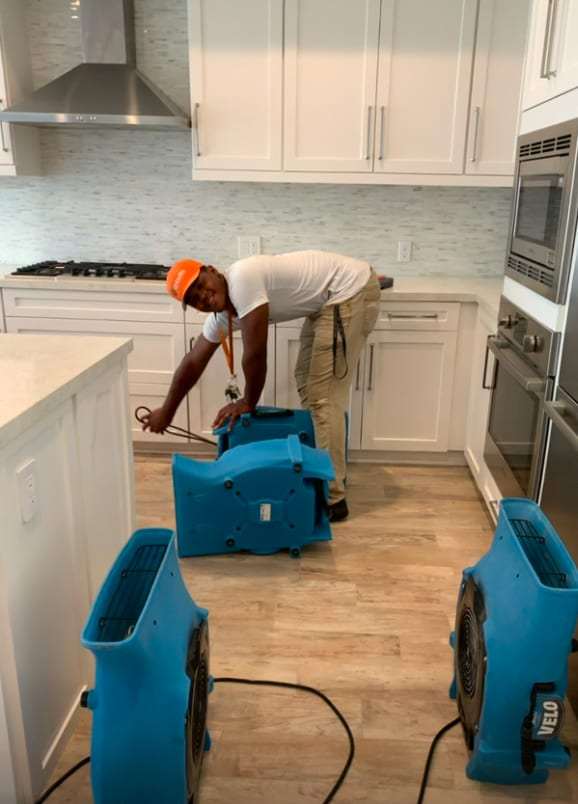
Technician placing air movers in a kitchen after a leak. A general example of this kind of work, not a photo of a particular home, business or job.
The situation
Illustrative example. Not a real job or customer.
In this invented example, a July afternoon storm drops heavy rain and hail on a 1960s ranch with a finished basement. The window well outside a basement office is half full of old leaves, and a downspout nearby discharges right next to it. Within minutes, the well fills, hail piles against the glass and water starts pouring in around the frame.
- The owner hears water and goes downstairs. Seeing water near a power strip, they switch off the basement circuits at the panel, which is upstairs in this house.
- Once lightning has passed, they bail the well from outside and pull hail and leaves off the gravel. They move the downspout extension away.
- They photograph the full well, the window and the wet room.
- Their insurer explains that surface water may be handled differently from a plumbing leak and asks for documentation.
- The assessment classifies the water as contaminated. Carpet, pad and the lower drywall in the office are removed; framing and concrete are cleaned and dried.
- A contractor clears the well, adds fresh gravel, confirms the drain connects to the perimeter system and installs a clear egress-rated cover.
The office needed new carpet and drywall, but the water was confined to one room because the owner cut power, stopped the inflow and redirected the downspout quickly. The well has not overflowed since in this example.
Key choices
- IfThe owner wanted to save the carpetThenSurface water is contaminated, so the carpet and pad were removed rather than dried.
- IfPaperwork in boxes on the floor was wetThenItems were photographed, then sorted: irreplaceable papers were air-dried separately; the rest was discarded.
- IfThe coverage question was unclearThenMitigation went ahead with full documentation while the insurer reviewed the claim.
Habits that would have prevented this
- Clearing leaves from window wells in spring and fall.
- Keeping downspouts aimed away from wells.
- Testing well drainage with a bucket of water.
- Storing boxes on shelves rather than the basement floor.
- Walking the outside of the house during the first big storm of spring to see where water collects.
- Adding a battery-powered water alarm on the floor of finished below-grade rooms.
Common questions
Why was the drywall removed if the water only stood for a short time?
Surface water carries soil, debris and bacteria. Porous materials it soaks into, like the bottom of drywall, carpet and pad, generally cannot be cleaned reliably, so they are removed even after a brief exposure.
Would a sump pump have helped in this example?
Not much. The water entered through the window, not up through the slab. Clearing the well, fixing its drain and redirecting the downspout addressed the actual path.
General information for Lakewood, not a quote or professional advice. In an emergency, call 911.